Many phenomena are influenced by the relative humidity level, and they can cause production processes to be less efficient, less predictable, and more prone to producing products that don’t meet specification.
GMP compliance in pharmaceutical manufacturing requires that any process, person, environment, or equipment with direct impact on the quality and safety of the product being produced must operate within specified limits.
These specified limits should be under the direct control of the manufacturing team, with countermeasures available in the event of a problem. In addition, any other part of the production or storage processes that have an indirect impact must also be assessed for possible risk impact.
Humidity may not seem like an obvious cause of problems, or something that could even result in production being non-compliant, but this can and does occur. Just because one does not see an issue doesn’t mean there isn’t a problem. Many phenomena are influenced by the relative humidity level, and they can cause production processes to be less efficient, less predictable, and more prone to producing products that don’t meet specification.
Some common issues that can arise from poor humidity control are:
• Increased energy consumption
• Altered aesthetic presentation
• Microbiological growth
• Chemical reactions
• Poor test equipment accuracy
• Moisture regain
• Changes in electrical conductivity
• Effects on operators
• Degradation of buildings and products
• Condensation
• Product drying issues
• Corrosion
• Reduced refrigeration plant efficiency
• Reduced productivity
• Ice build up
Figure 1 shows the influence on storage of a variety of materials as relative humidity changes. Storage in this sense is not just restricted to
warehousing, but also applies to any material, object, or equipment that remains stationary in a fixed location for extended periods. So, think of this also in the context of equipment and fittings within a pharmaceutical manufacturing plant.
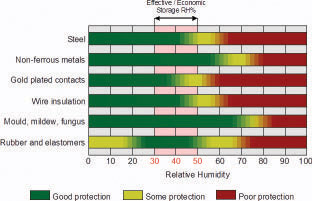 Figure 1: Effect of RH% on materials in static locations.
It is important to note the relationship between relative humidity (RH%) and air temperature, as variations in temperature also will affect the
RH%. For example, a sufficiently large drop in air temperature can result in water vapor condensing out. Alternatively, cold surfaces will cause condensation to form if the surface temperature drops below the dew point of the air around it.